(b) Describe two kinds of pidgins and three characteristics of a Pidgin language.
View Ans
2. “Code switching is a vital communication tool amongst bilingual speakers.” Verify this statement by giving eight purposes for code switching.
View Ans
3. “Kiswahili is nowadays becoming more of a first language than a second language to most young Tanzanians.” Substantiate this statement by giving eight factors with relevant examples.
View Ans
SECTION B (20 Marks) : LANGUAGE SKILLS
Answer one (1) question from this section.
4. (a) What is note-taking? Describe three characteristics of good notes.
View Ans
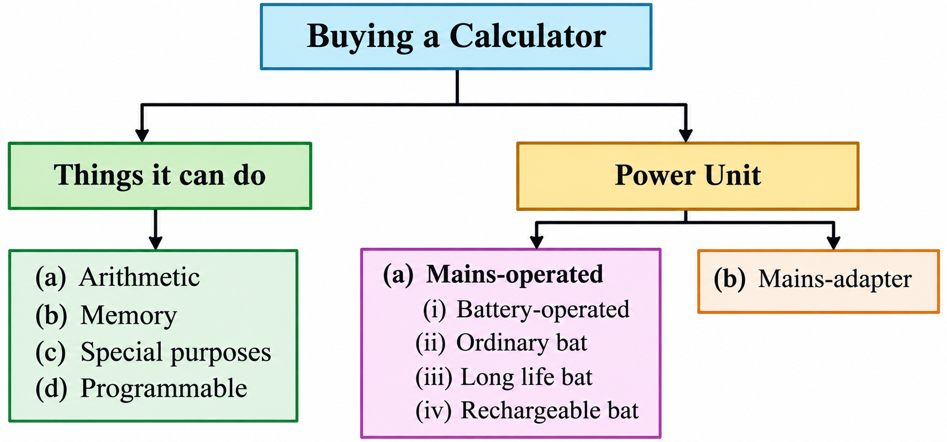
(b) You have just read a text on “Buying a Calculator” and you have made the following branching notes in your notebook. Represent the branching notes in a notes format.
View Ans
5. (a) Using appropriate examples from English Language, describe five functions of stress.
View Ans
(b) Divide the following words into their syllables using a dash (-), keeping them in their normal spelling and then mark stress by underlining the syllable on which the primary stress falls:
- thunder
- submit
- inhabit
- phonetics
- employee
View Ans
SECTION C (20 Marks) : WORD FORMATION
Answer one (1) question from this section.
6. (a) Identify the inflectional morphemes in the following sentences and then show whether they are noun inflectional, verb inflectional, or adjective inflectional.
- She is crying uncontrollably.
- The strongest man in the world is he who stands alone.
- The students’ performance is reasonably good.
- All the submariners were hospitalised.
View Ans
(b) Write the three allomorphs of the regular past tense morpheme in English Language. Provide one word to illustrate each of the allomorphs.
View Ans
7. (a) For each of the following words, write the suffix, give the meaning for each suffix and make one meaningful sentence for each word.
- genocide
- cigarette
- bakery
- dusty
- childish
View Ans
(b) Change the following words into nouns:
- anxious
- proud
- angry
- young
- funerary
View Ans
SECTION D (20 Marks) : LANGUAGE USE
Answer one (1) question from this section.
8. (a) Differentiate technical translation from literary translation by giving five points.
View Ans
(b) Translate the following expressions into Kiswahili Language by considering the contextual meaning of the source language.
- Blood is thicker than water.
- It’s better late than never.
- Out of sight...Out of mind.
- There is no smoke without fire.
- What goes up must come down.
- Seeing is believing.
- You reap what you sow.
- It’s no use crying over spilt milk.
- Where there’s a will there’s a way.
- One rotten apple will spoil the whole barrel.
View Ans
9. (a) Using relevant examples, briefly explain each of the following terms as used in translation:
- Translator
- Source text
- Target language
- Overtranslation
- Fidelity in translation
View Ans
(b) Translate the following expressions into English Language and state the things which pose a challenge in translating them:
- Yohana anaishi mkoani Kigoma.
- Dawa ya moto ni moto.
- Watalii wale wanakula wali kwa kisamvu.
- Babu yangu amekula chumvi nyingi sasa.
- Shirika la UDA limeajiri madereva zaidi ya kumi.
View Ans
THE UNITED REPUBLIC OF TANZANIA NATIONAL EXAMINATIONS COUNCIL, ADVANCED CERTIFICATE OF SECONDARY EDUCATION
EXAMINATION
122/2 ENGLISH LANGUAGE 2
(For Both School and Private Candidates)
Time: 3 Hours Friday, 05th May 2017 a.m.
Instructions
- This paper consists of nine (9) questions in sections A, B, C and D.
- Answer five (5) questions, choosing one (1) question from each section. Question three (3) is compulsory.
- Each question carries twenty (20) marks.
- Cellular phones are not allowed in the examination room.
- Calculators are not allowed in the examination room.
- Write your Examination Number on every page of your answer booklet(s).
SECTION A (40 Marks) : COMMUNICATION IN ENGLISH
Answer two (2) questions from this section. Question three (3) is compulsory.
1. Since Literature has been in existence for a long time, it has lost its value in the modern world. Discuss against this contention by giving examples.
View Ans
2. Give the literary terms referred to by the following characteristics:
- Involves folktales, folk songs, fairy tales, fables, riddles, etc.
- Any literary work that uses the author’s imagination to invent characters, events, places and situations.
- A character in a story or poem, who deceives, frustrates and works against the main character.
- The major divisions of a play.
- Organisation of verses composing a stanza of 8 lines.
- Attitudes toward the subject or the audience in a literary work.
- Repeated verse at the end of each stanza.
- A word or an image that signifies something other than what it represents.
- A woman character who is strong enough to overcome her opponents.
- Exaggeration of ideas.
View Ans
3. (a) Give five characteristics of a novel.
View Ans
(b) With examples, define the following literary terms:
- Metaphor
- Personification
- Characterization
- Euphemism
- Figures of speech.
View Ans
SECTION B (20 Marks) : PLAYS
Answer one (1) question from this section.
List of readings:
- Betrayal in the City- Francis Imbuga
- I Will Marry When I Want- Ngugi wa Thiong’o & Ngugi wa Mirii
- The Bride- Austin Bukenya
- Lwanda Magere- Okoiti Omtatah
- An Enemy of the People- Henrik Ibsen
- Black Mamba- John Ruganda
4. Show the techniques which the playwrights of two plays you have read used to convey their message to the society. (Use four points from each reading).
View Ans
5. It is argued that poverty is a result of selfish tendencies of some of those who are entrusted to lead the general public. With reference to two plays, justify your stand in the argument. (Use four points from each reading).
View Ans
SECTION C (20 Marks) : NOVELS AND SHORT STORIES
Answer one (1) question from this section.
List of readings:
- Encounters from Africa- Macmillan Education Limited
- The Beautyful Ones Are Not Yet Born- Ayi Kwei Armah
- A Man of the People- Chinua Achebe
- Divine Providence- Severin N. Ndunguru
- The Rape of the Pearl- Magala Nyago
- Vanishing Shadows- Namige Kayondo
- His Excellency the Head of State- Danny Safo
- A Season of Waiting- David Omowale
6. State leaders in African societies are notably shadows of colonial masters. Verify this statement by citing two readings you have done under this section. (Use four points from each of the readings).
View Ans
7. Show how the contemporary world is reflected in any two novels you have read under this section. (Use four points from each reading).
View Ans
SECTION D (20 Marks) : POETRY
Answer one (1) question from this section.
List of readings:
- Selected Poems- Institute of Education
- The Wonderful Surgeon and other Poems- Charles Mloka
8. Poetry like other works of art brings to surface society issues. Support this view using four poems. (Use four points from each poem).
View Ans
9. Read the following poem and answer the questions that follow.
The Awful Dentist - Jwani Mwaikusa
He read medicine,
Specializing in the tooth,
And graduated with honours
With a new thesis
To cure the aching malady.
“Our teeth shall be alright”
People chanted, welcoming his services.
And he started work, prompt and immediate.
They brought him all the teeth they had
Decaying teeth, aching teeth, strong teeth.
And he started working on their jaws
Diligently pulling out every tooth
From the jaws of every month,
And they paid him with meat
Which now they could not eat.
And so on went the dentist
Making heaps and heaps of teeth
Useless. Laying them waste
Without fear that soon
Very soon indeed,
He would have no teeth to attend to,
No tooth for which to call himself a dentist.
Questions
(a) Extract a verse from the poem above which shows each of the following poetic devices:
- Hyperbole
- Symbolism
- Satire
- Stanza with the abcbbdd rhyming pattern
- Parallelism
- Strong-Weak-Strong-Weak-Strong-Weak-Strong rhythmic pattern
(b) Summarize the main idea in each stanza.
View Ans

 For Call,Sms&WhatsApp: 255769929722 / 255754805256

 Matokeo Darasa VII 2025
Matokeo KIDATO CHA II 2024